
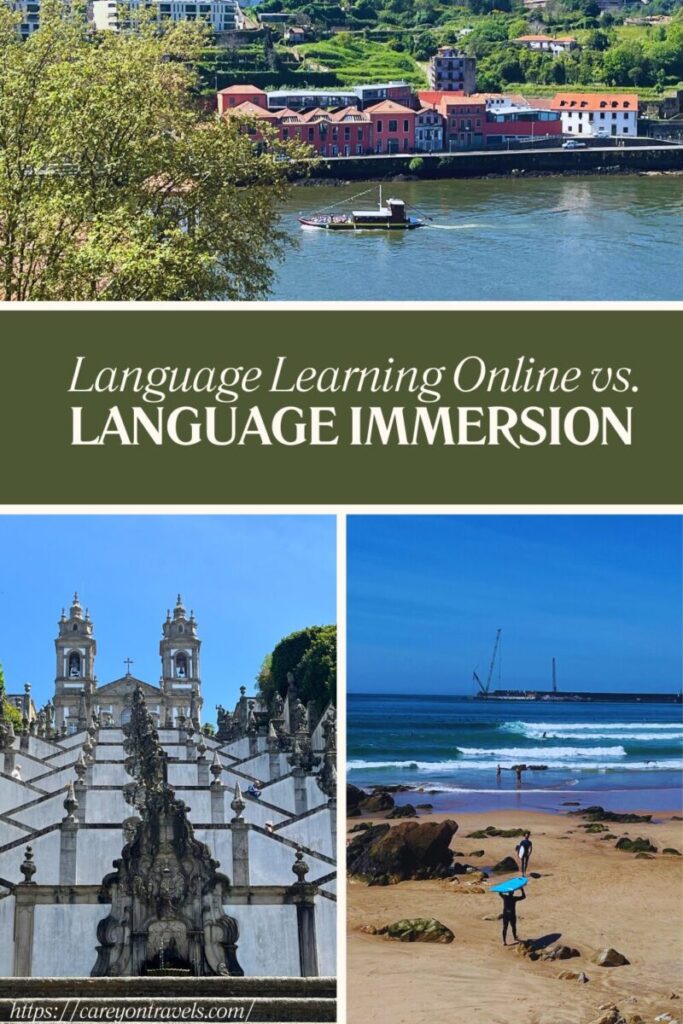
After a year of tapping through Duolingo lessons, I thought I had a decent grasp of Portuguese—until I found struggling to keep up with a fast-paced conversation in Porto. That’s when I decided to test something bigger: how does a year of app-based language learning stack up against a one-week immersive program in Portugal? In this post, I dive into the real-world differences between the two approaches, what each one taught me, and which method actually helped me speak with more confidence. If you’ve ever wondered whether travel really is the best language teacher, read on.
This post may contain affiliate links. If you make a purchase through these links, we will earn a small commission at no additional cost to you. We recommend products we have personally used or verified. Read the full disclosure here.
If you don’t have time to read this now, pin it for later!

A Bit of Background…
In all fairness, I didn’t undertake this effort just to see which language learning approach is more effective. I’ve spent extensive time in Portugal, though never made enough of an effort to learn Portuguese. Before starting this concerted language learning effort, I could order food in restaurants and could recognize some words, but that’s about it. Given that we are spending more and more time in Portugal each year, I want to be able to communicate well in Portuguese.
1 Year of Language Learning Online
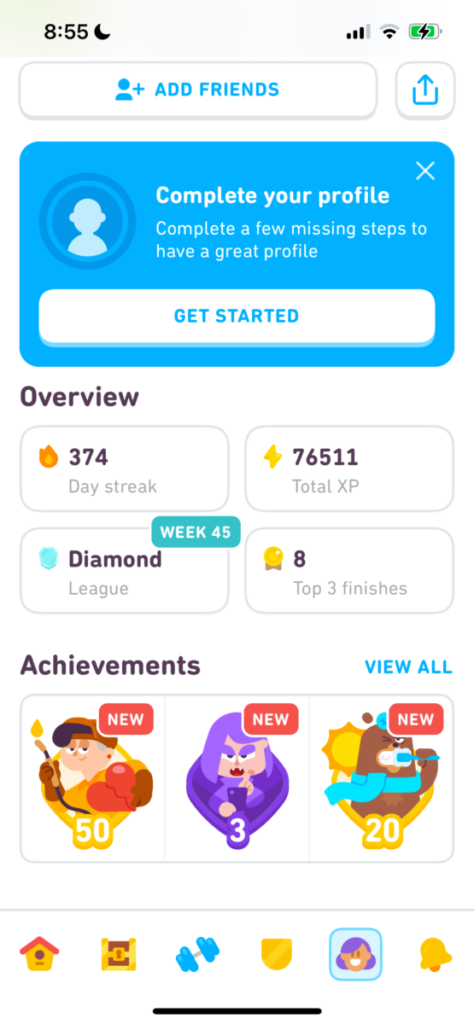
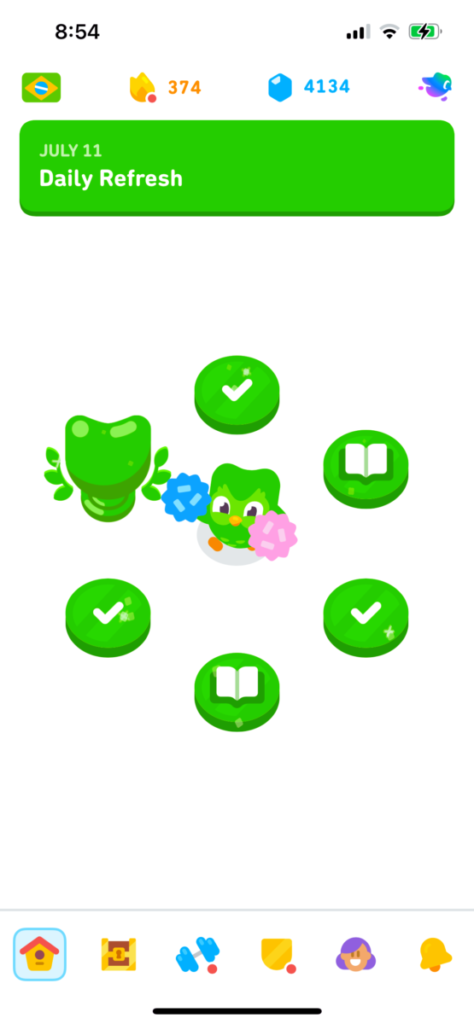
A few people I knew had used Duolingo and recommended it, so I decided to give it a try. Duolingo only offers Brazilian Portuguese, which is not ideal, but I figured it could give me a jump start, which I’d fine tune later. I completed 1 full year of at least one lesson per day, though most days I did more. This equates to 10-30 minutes per day. I spent an estimated 100-150 total hours in that year (sounds like a lot in hindsight). I did enough work consistently to reach the Diamond League of top performers. Just before my 1 year anniversary, I finished the Duolingo Portuguese program, and now have been continuing with their daily refresh lessons. Though I was feeling somewhat confident in my vocabulary, I still didn’t feel like I could hold a conversation.
I’d recommend complementing Duolingo learning was the Coffee Break podcast series. This helped me with listening and learning how to engage in common conversations (e.g., how to by train tickets, order coffee).
1 Week of Vacation Language Immersion Class
I enrolled in a language vacation immersion class in Porto, where we met for 4 hours/day for one week. That left me with afternoons free to explore some wonderful beaches near Porto. After nearly a year of Duolingo, I took a placement test for the class, and was placed into the A1 class. That meant I was effectively a total beginner! I did recognize and understand most of the vocabulary on the test, but I was lacking the grammar rules needed to move to the A2 class.
If you are looking for a great vacation language immersion program in Portugal, check out Oficina de Português in Porto. I have no affiliation with this program. I simply enjoyed the classes that I attended.

Language Immersion Program vs Language Learning Online
Here’s what I got out of my 1 year of Language Learning Online vs 1 week of the Vacation Language Immersion Program.
| Category | 1 Year Language Learning Online | 1 Week Vacation Language Immersion Program |
|---|---|---|
| Greetings, Introductions, Pleasantries | Basic words and phrases for hello, goodbye, please and thank you, and some pleasantries | More extensive introductions and pleasantries. This included interactive Q&A about where I come from, where I live, what I do, what my hobbies are, my job, languages I speak, my family |
| Vocabulary | Duolingo provided a good amount of vocabulary knowledge, with strong reinforcement. There were a smattering of words that I had to re-learn for Portugal | I learned fewer vocabulary words than I learned in the year of Duolingo, though I also learned some new words |
| Days of the week, months and seasons | Fully covered | Fully covered |
| Nationalities | Fewer nationalities covered | Extensively covered |
| Numbers and letters | Numbers through one hundred, one thousand, one million Pronunciation of the letters was not covered | Numbers through 8000+, one million. Learned construction of complex numbers. Pronunciation of alphabet letters was covered |
| Verb conjugation | Duolingo doesn’t teach verb conjugation per se. Despite this, I was exposed to many present, past, future, and even conditional verbs. I pieced together some verb conjugations | Verb conjugation was a heavy focus. We learned present tense of regular and irregular verbs and a bit of future tense |
| Grammar rules | Duolingo doesn’t teach grammar rules per se. I figured out some of the grammar rules based on what I was reading or writing, but didn’t fully understand the why’s behind many of these | Grammar was a core focus. Articles were covered, including explanation on rules (e.g., when to use “ser” vs “estar”) |
Consistency vs. Intensity
Language Learning Online: One of the biggest advantages of Duolingo is the ability to practice daily. A year of consistent, bite-sized lessons can build a strong foundation in vocabulary without overwhelming the learner. The gamified approach keeps motivation high, perfect for casual learners and those with busy schedules.
Language Immersion Program: On the other hand, immersion classes are intense. Being surrounded by the language and culture for a week forces you to use what you know in real-time situations. This can dramatically improve your conversational skills and help you overcome the fear of speaking. 2-4 weeks of a language immersion program would be much better than 1 week.
Depth of Learning
Language Learning Online: While Duolingo continuously updates its courses to keep them engaging, it sometimes lacks depth. The focus is more on translation rather than on creating your own sentences, which can be a limitation if you’re looking to become fluent.
Language Immersion Program: Immersion classes excel in providing a deep dive into the language. You learn not just the language but also cultural nuances, which are often missed in app-based learning. This method helps in understanding context and idiomatic expressions, crucial for achieving fluency.

Cost and Accessibility
Language Learning Online: It’s hard to beat free or the premium (Super Duolingo) version at a relatively low cost (currently under US$100 per year). Duolingo is accessible on your phone or computer, allowing you to learn anywhere, anytime.
Language Immersion Program: Typically more expensive, immersion classes can also include travel costs if they are held in a location where the language is natively spoken. However, these costs come with the benefit of direct interaction with teachers and peers, which is invaluable for real-time feedback. After class, you can continue to immerse yourself, using what you’ve learned in social settings. Consider using these 5 Easy Steps to Calculating Your Trip Budget.

Suitability
Duolingo: Ideal for beginners or those looking to refresh their skills. It's also great for learners who prefer a self-paced approach without the pressure of real-time conversation.
Immersion Class: Best suited for learners who have a basic understanding of the language and are looking to achieve true fluency. It's particularly beneficial for those who thrive in structured environments and need that extra push to speak.

Results
Choosing between Language Learning Online and a Vacation Language Immersion Program depends largely on your goals, lifestyle, and how you learn best. If you're aiming for basic understanding or casual learning, an online program like Duolingo is an excellent start. But if you really want to become fluent and be able to effectively communicate, sign up for a language immersion program. Don't forget to leave time for exploring the area before or after your class (or on weekends). I enjoyed some amazing day trips from Porto the week before this class.
In the end, combining both methods might just be the best way to learn a new language. At least it was in my case. Since returning home from my language immersion program, I signed up for weekly individual classes with a Portuguese teacher to continue my learning. I still have quite a long way to go, but feel that I am on the right path. I am still doing my language learning online, though I am just doing some refresher exercises each day.
If you liked this post, pin it for later!
Travel Resources
We recommend booking through our preferred travel booking sites below.
| Air Travel | SkyScanner |
| Lodging | Booking.com, VRBO.com, Expedia.com, Hostelworld |
| Tours and Activities | Viator.com, GetYourGuide.com, TakeWalks.com, Tinggly.com |
| Car rentals | Discovercars.com |
| Travel insurance | Squaremouth |
| Bike and scooter rentals | BikeBookings.com |
| Train tickets | RailEurope |
| Bus tickets | Busbud |




Leave a reply